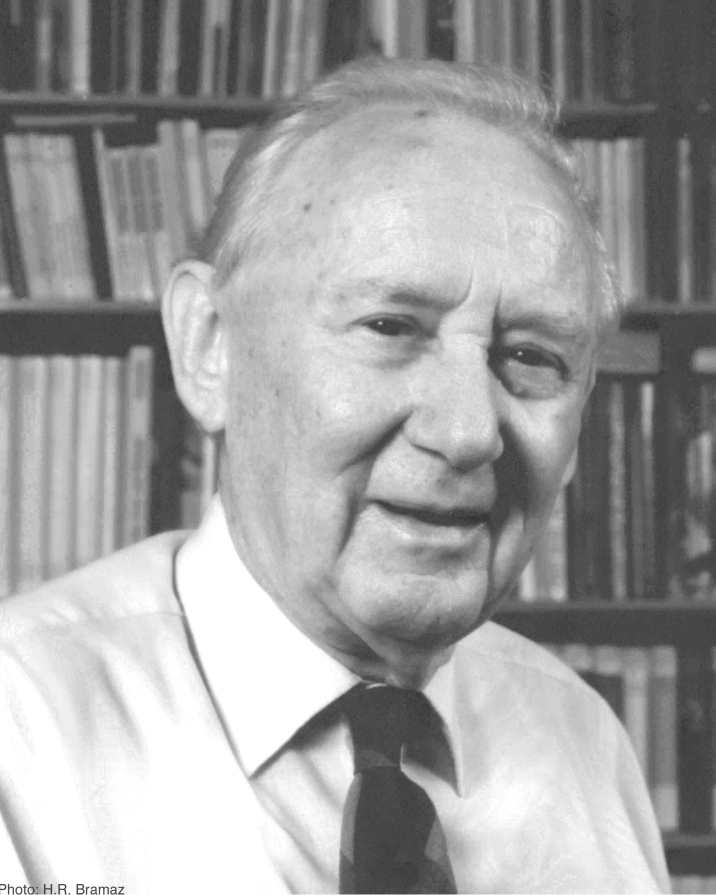
Walter Hälg, the pioneer of reactor technology and neutron scattering in Switzerland, passed away peacefully on December 28, 2011 at the age of 94. He was well known to the world wide neutron scattering community not only through his numerous contributions in instrumentation and science, but also by his generous sponsorship of the Walter Hälg Prize which has been awarded biennially to distinguished scientists by the European Neutron Scattering Association (ENSA) since 1999.
Born in Basel in 1917, citizen of Basel, Switzerland, he was one of the pioneers in the area of neutron science. Experimental physics, theoretical physics, chemistry, and mathematics were the four fields that took up his student time at the Basel University where in 1943 he received his PhD in molecular physics. From 1943 to 1946 he worked in particle physics at the Physical Institute of the University of Basel and on the construction of a 1 MeV Cockroft-Walton accelerator in Basel. He spent the years 1946-1960 at the Brown Boveri Company (BBC, predecessor of the current ABB) in Baden, Switzerland, and was promoted head of the physics department in 1953. During his time at BBC, he worked on the development of the Swiss heavy water reactor DIORIT at Würenlingen, which went critical on 26 August 1960. In between, i.e. 1952/1953, he was sent to the Dutch-Norwegian Reactor Research Institute JENER in Kjeller, Norway.
In 1960, he was named full Professor and director at the newly founded “Institut für Reaktortechnik IRT” at ETH Zürich, with an outstation at the EIR Würenlingen. His main fields of research focused on reactor theory, numerical mathematics, neutron diffraction, and computer science. He was involved in the construction of the neutron spectrometers at the reactor DIORIT as well as in the development of a multiprocessor computer (16 CPU’s) for solving partial differential equations. After decommissioning of the reactor DIORIT in August 1974, he carried out the first calculations for a spallation source using the surplus protons of the 590 MeV ring of the near SIN institute for neutron production, seeing the limitations for neutron scattering at the reactor SAPHIR in Würenlingen, ideas supported also by Walter E. Fischer.
Professor Hälg’s contributions to neutron scattering are extensive. He supervised many PhD students in neutron scattering, among them the A. Furrer, P. Fischer, and J. Schefer. For 10 years, he was a member and president of the Research Board of the ETH Zürich until his retirement in autumn 1984 when he became an honorary member of the executive board of the Swiss Neutron Scattering Society. He was also honorary member of the distinguished Physical Society of Zürich.
Albert Furrer continued Walter Hälg´s work as the new head of the Laboratory for Neutron Scattering. In 1996, the neutron scattering activities were moved from the reactor SAPHIR to the newly built continuous spallation neutron source SINQ at the Paul Scherrer Institute, a merger between SIN and EIR.
Albert Furrer was acting chairman of the European Neutron Scattering Association when he proposed Professor Hälg to sponsor and to give his name to the Prize. The award is given to European scientists who have achieved an outstanding research program in neutron scattering with a long-term impact on scientific and /or technical neutron scattering applications. The scope of this prize is coincident with the result of the professional career of the man who gave his name to this prize. Walter Hälg will be remembered by many in the field not only as a pioneer in reactor technology and neutron scattering but also as a friend. His wife Madeleine Hälg-Degen continued to sponsor the highly prestigious ENSA Prize until her death in 2017. In the future it will be called the Walter and Madeleine Hälg Prize. We are pleased that SwissNeutronics AG, Klingnau, Switzerland, kindly agreed to take over the sponsorship.